
It’s official: to revisit the microscopic dangers of Brookhollow in Grounded 2, you’ll need more than just courage—you’ll need beefier hardware. With Obsidian Entertainment’s recent revelation of system requirements, the cooperative survival sequel stakes its claim as a technical showcase. But what do these demands mean for veterans of the original, and for anyone whose PC configuration is starting to show its age? Here’s a detailed breakdown of the new specs, potential upgrade paths, and the broader context within the survival genre.
Breaking Down the New System Requirements
Obsidian has set forth a significant hardware bar for Grounded 2. Compared to the first game, these requirements roughly double or triple key resources. While no SSD is explicitly mandated, the recommended components aim to deliver smooth performance and capitalize on advanced graphical features. Below is a summary of the announced specifications:
- 16 GB of RAM minimum (versus 8 GB in Grounded 1)
- Graphics card: NVIDIA GTX 1070 or AMD RX 5700 minimum; RTX 3080 or RX 6800 XT recommended
- CPU: Intel Core i7-10700K or equivalent AMD Ryzen processor
- Disk space: 40 GB—five times the original’s footprint
- Storage Medium: HDD acceptable but SSD strongly advised for faster loading
| Feature | Specification |
|---|---|
| Publisher | Obsidian Entertainment |
| Release Window | 2025 (exact date TBA) |
| Genres | Survival, Cooperative, Adventure |
| Platforms | PC (Steam, Microsoft Store), Xbox Series X|S |
Why the Increase in RAM and GPU Power?
Doubling the RAM requirement from 8 GB to 16 GB reflects Grounded 2’s expanded world systems—richer environments, more NPC interactions, and deeper crafting trees. In gaming terms, RAM (Random Access Memory) stores active data, so higher capacity reduces hiccups when loading detailed textures or managing AI behaviors.
On the graphics front, demanding a GTX 1070 as a baseline and recommending an RTX 3080 underscores a leap toward high-fidelity visuals. Modern GPUs leverage features like hardware-accelerated ray tracing, which simulates realistic lighting at the cost of processing power. Grounded 2’s updated shaders and dynamic weather effects likely hinge on these technologies.
Impact on Current PC Configurations
For anyone whose gaming rig dates back to pre-2018 hardware, these new specs may present a true roadblock. Laptops with integrated graphics, budget-tier GPUs, or machines still running on 8 GB of RAM will struggle to maintain stable frame rates—especially in four-player co-op. However, gamers with mid-range builds from the last five years should be able to tweak settings downward in exchange for playability.
Notably, Obsidian stopped short of making solid-state drives a strict requirement. While mechanical hard drives (HDDs) can handle the 40 GB install, they introduce longer load times. An SSD significantly reduces scene transitions, inventory loading, and world streaming delays, making it a worthwhile upgrade for a smoother survival sandbox experience.
Comparisons Within the Survival Genre
The sandbox survival category has evolved into a showcase for cutting-edge hardware. Titles like ARK 2 push requirements into ultra-high-end territory, often necessitating top-tier GPUs and CPUs. Compared to those giants, Grounded 2 remains relatively accessible—while still flirting with next-gen features. Obsidian’s approach balances technical ambition with broader reach, avoiding the complete alienation of last-generation rigs.
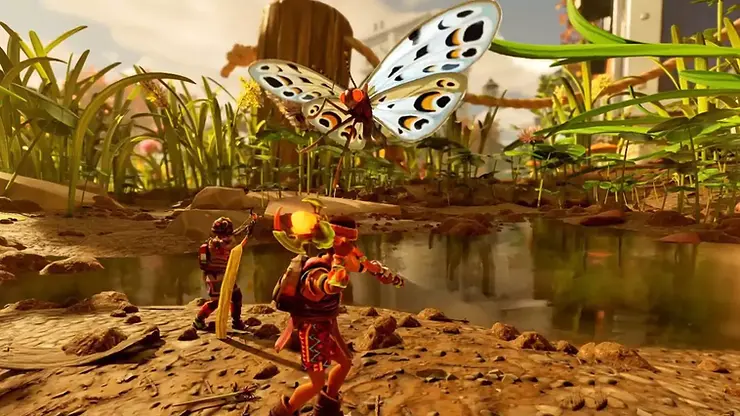
In the context of procedural generation—where worlds are algorithmically created on the fly—Grounded 2’s demands indicate more expansive biomes, dynamic creature behaviors, and refined base-building tools. These enhancements translate to deeper immersion, provided your system can keep up.
Practical Upgrade Advice
If your PC barely meets the original Grounded’s specs, consider these targeted improvements:
- RAM Upgrade: Increasing from 8 GB to 16 GB DDR4 or DDR5 is typically the most affordable step.
- GPU Boost: Aim for at least a GTX 1070 or AMD RX 5700. For future-proofing, an RTX 3080 or equivalent delivers headroom for high settings.
- Storage Shift: Moving your game library to an NVMe SSD cuts load times and improves streaming performance.
- CPU Check: Ensure your processor is on par with an i7-10700K or a recent Ryzen chip. If not, a bundle upgrade—motherboard plus CPU—may be necessary.
Remember to verify your power supply unit (PSU) can handle new components, and ensure adequate case airflow to prevent thermal throttling.
Broader Implications for Players
Grounded 2’s heightened requirements illustrate a growing trend: survival sandboxes are no longer niche experiments but flagship showcases for advanced rendering and complex AI systems. While this progression enriches gameplay possibilities—more realistic insect swarms, detailed exterior lighting, and sophisticated crafting mechanics—it also raises barriers for players unwilling or unable to upgrade.

Obsidian’s decision to keep the entry point just below ultra-high-end extremes is a nod to their community, many of whom embraced the first Grounded on mid-range rigs. Yet, subtle pressure remains: to enjoy the sequel at its best, one must invest in hardware every few years, reflecting an industry-wide shift toward a “pay-for-performance” model.
Conclusion: A Technical Leap with Open Doors
Grounded 2 clearly ushers in a “next-gen” era for miniature survival. It demands substantial upgrades—particularly in RAM and GPU capability—while stopping short of excluding mid-tier systems entirely. Players who loved the original can still access Brookhollow’s perils after a modest hardware refresh, and those upgrading will benefit from richer visuals, deeper gameplay systems, and faster loading times.
Ultimately, Obsidian strikes a balance: setting a higher bar without locking out the majority of its audience. Whether this investment pays off in truly transformative features or simply serves as graphical window-dressing will become clear once we venture back into that towering backyard of hazards. For now, prepare your PC toolkit—and perhaps your wallet—and ready yourself for a survival sequel that aims to be as demanding as it is immersive.
TL;DR
- Grounded 2 requires 16 GB RAM, GTX 1070/RX 5700 minimum, RTX 3080 recommended, and 40 GB disk space.
- No mandatory SSD, but one is advised to reduce load times.
- Mid-range rigs (last five years) can still play with reduced settings; older setups will need upgrades.
- Obsidian balances technical ambition with accessibility, pushing the survival sandbox genre forward.
Laisser un commentaire