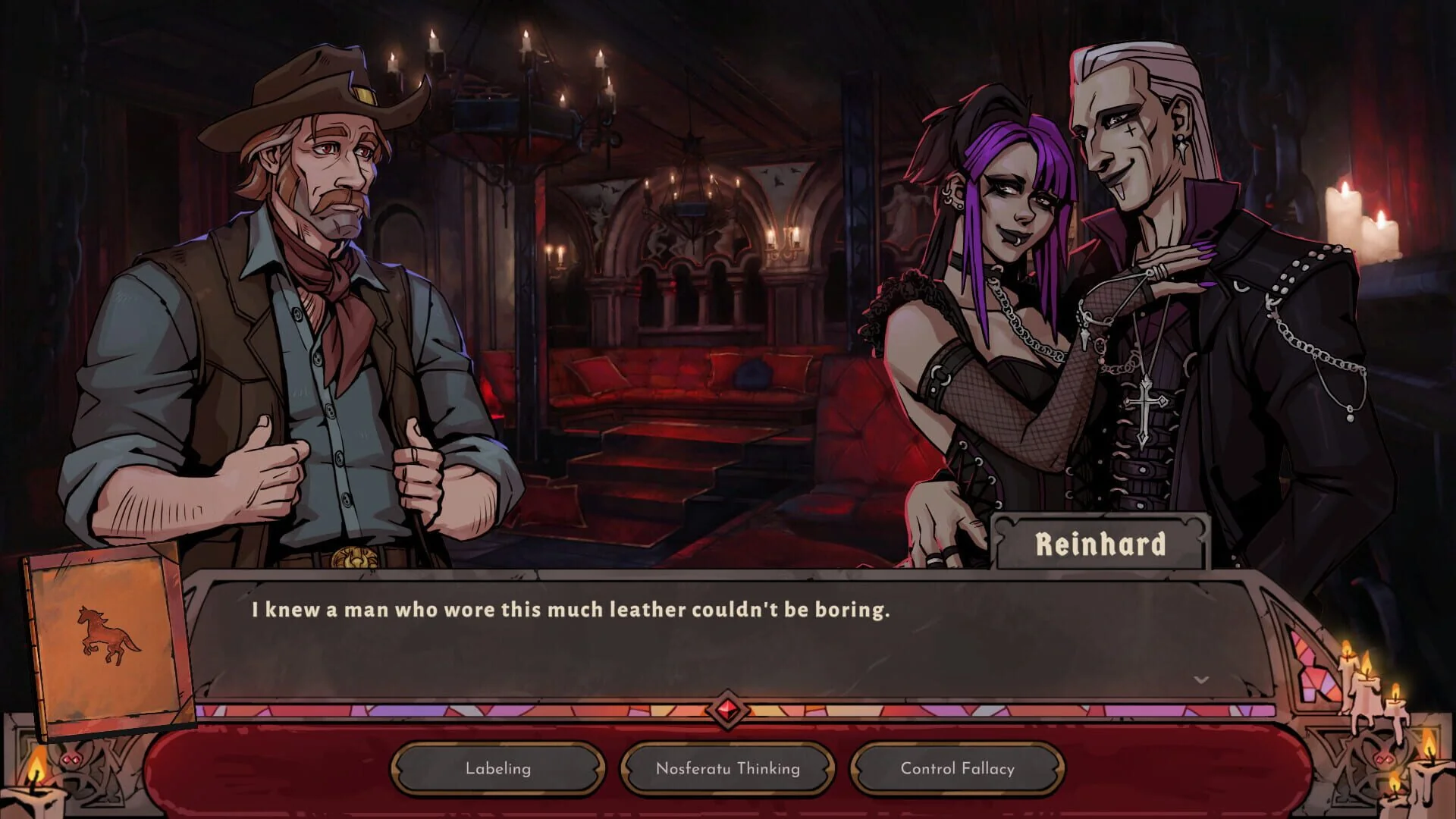
I went into Vampire Therapist expecting a throwaway gag: “ha ha, vampires in therapy.” What I got instead was a nine-hour crash course in Cognitive Behavioral Therapy wrapped in a surprisingly affecting visual novel… where I also happen to be a 200-year-old cowboy vampire.
By the time the credits rolled on Xbox Series X, I’d laughed at more bad bloodsucker puns than I care to admit, winced my way through stories of abuse and addiction, and caught myself spotting the same “cognitive distortions” in my own thinking that I’d just helped undead clients unpick. It’s weirdly educational, occasionally clumsy, and often excellent.
Key Takeaways
- Clever CBT integration: Uses real Cognitive Behavioral Therapy concepts in an approachable way, with memorable names and examples that genuinely stick.
- Outstanding characters & voice acting: A small but sharp cast of vampires, brought to life by committed performances and strong writing.
- Heavy themes handled with care: Suicide, abuse, addiction and trauma are central; dark humor keeps it bearable without trivializing them too often.
- Low player agency: Choices rarely change outcomes and “wrong” answers get corrected, making it feel more like an interactive lesson than a branching story.
- Chilled, low-stress pacing: Simple mechanics, a nightclub hub, and light minigames make it ideal if you want narrative over challenge.
- Minor technical issues: A few small glitches and transitions hiccups on Xbox, but nothing that broke the experience.
- Overall score: 8/10 – a smart, heartfelt visual novel that trades deep interactivity for a unique mix of therapy and vampiric drama.
Vampires, Nightclubs, and Neuroses: What Vampire Therapist Actually Is
Vampire Therapist is a BAFTA-nominated indie visual novel from Little Bat Games, first launched on PC in 2025 and now available on PlayStation, Nintendo Switch, and Xbox Series X. You play Sam Wells, a 200-year-old vampire from the Wild West who’s run as far as he can from his past and wound up in Germany.
Sam stumbles into Immernacht, a sleek vampire nightclub owned by Andromachus (“Andy”), a 3,000-year-old therapist who looks like he stepped out of an immortal fashion shoot. Sam persuades Andy to take him on as a therapist-in-training, and from there the whole game becomes a series of therapy days: sessions with clients, debriefs at the bar with Crimson the bartender, and occasional glimpses into Sam’s own emotional damage.
Structurally, it’s a classic visual novel: you read a lot, click through dialogue, pick responses, and occasionally play light minigames. There’s no combat, no exploration gauge to manage, no fail states in the usual “gamey” sense. The hook here isn’t systems, it’s talking-and the way those conversations smuggle in cognitive science.
Real CBT in a Club Full of Bloodsuckers
The thing that grabbed me hardest is that Vampire Therapist doesn’t just wave vaguely at “therapy” as a theme. It leans straight into Cognitive Behavioral Therapy and builds its entire structure around it.
Each client session centers on a specific “cognitive distortion”-those unhelpful thinking patterns CBT tries to identify and reframe. The game teaches you how to spot and challenge them, but instead of dense textbook jargon, it rebrands them with vampire-flavored names. My favorite: “Nosferatu Thinking”, a perfect label for all-or-nothing, black-and-white thought patterns.
Across roughly nine hours, you steadily accumulate a toolkit: spotting catastrophizing, mind-reading, overgeneralizing, and so on. The repetition is deliberate. Through repeated dialogue choices and Andy’s gentle correction when you miss the mark, those patterns started lodging in my brain. Somewhere around hour five, one of my own spiraling thoughts popped up in real life and I caught myself going, “Ah, that’s some textbook Nosferatu Thinking right there.”
That’s Vampire Therapist at its best: it makes CBT stick by tying it to characters you care about. Helping a vampire reckon with immortality-driven depression is more memorable than reading an example about “Karen who’s anxious at work.” It’s playful, but it isn’t a parody of therapy. Under the jokes, the advice is recognizably aligned with real CBT techniques.
Important caveat: it’s still a game, not a replacement for an actual therapist. But as a way to demystify what CBT looks and sounds like, it’s surprisingly effective.
Heavy Themes, Dark Humor, and a Tricky Tone
Before anything else: this game needs a content warning, and it does give you one up front. Throughout Sam’s sessions you’ll confront:
- Suicidal ideation
- Emotional and physical abuse
- Addiction and self-destruction
- Trauma and complicated grief
The writing doesn’t shy away from any of that. I had a couple of moments where I just sat with the dialogue for a bit before moving on. The supernatural framing helps create a sliver of distance—you’re talking to vampires, not your neighbor—but the emotions are human and raw.
To keep the whole thing from becoming unbearable, Little Bat Games layers on dark, often very silly humor. There are blink-and-you-miss-them gags everywhere: coffin décor with a TV, “V-mail,” joke services like “OnlyZealots.” The overall tone reminded me a lot of What We Do in the Shadows—a weird mix of deadpan absurdity and genuine tenderness. I genuinely laughed out loud several times, usually at throwaway asides or visual touches rather than big punchlines.
Not every joke lands. Some of the more sexual humor leans into that slightly adolescent, wink-wink vibe that wore thin on me by the end. It rarely undercuts the serious scenes, but every so often I found myself thinking, “Okay, we get it. Vampires are horny.” When the script focuses on character-driven wit rather than shock-value naughtiness, it’s much stronger.
Clients Worth Caring About
Visual novels live or die on their cast, and here Vampire Therapist is in great shape. Your undead clients are well-drawn (literally and figuratively), all with distinct voices, histories, and problems. I won’t spoil specific arcs because discovering their baggage is half the fun, but this isn’t a row of quirky archetypes wheeled in for a single gag.
Each client comes back over multiple sessions, slowly opening up as you work through CBT concepts together. One immortal’s storyline slid from overconfident swagger into a surprisingly vulnerable confession that caught me off guard. Another bounces between sardonic humor and downright heartbreaking self-loathing. The more time I spent with them, the more invested I became in nudging them toward healthier patterns—even though, mechanically, I couldn’t really screw them up.
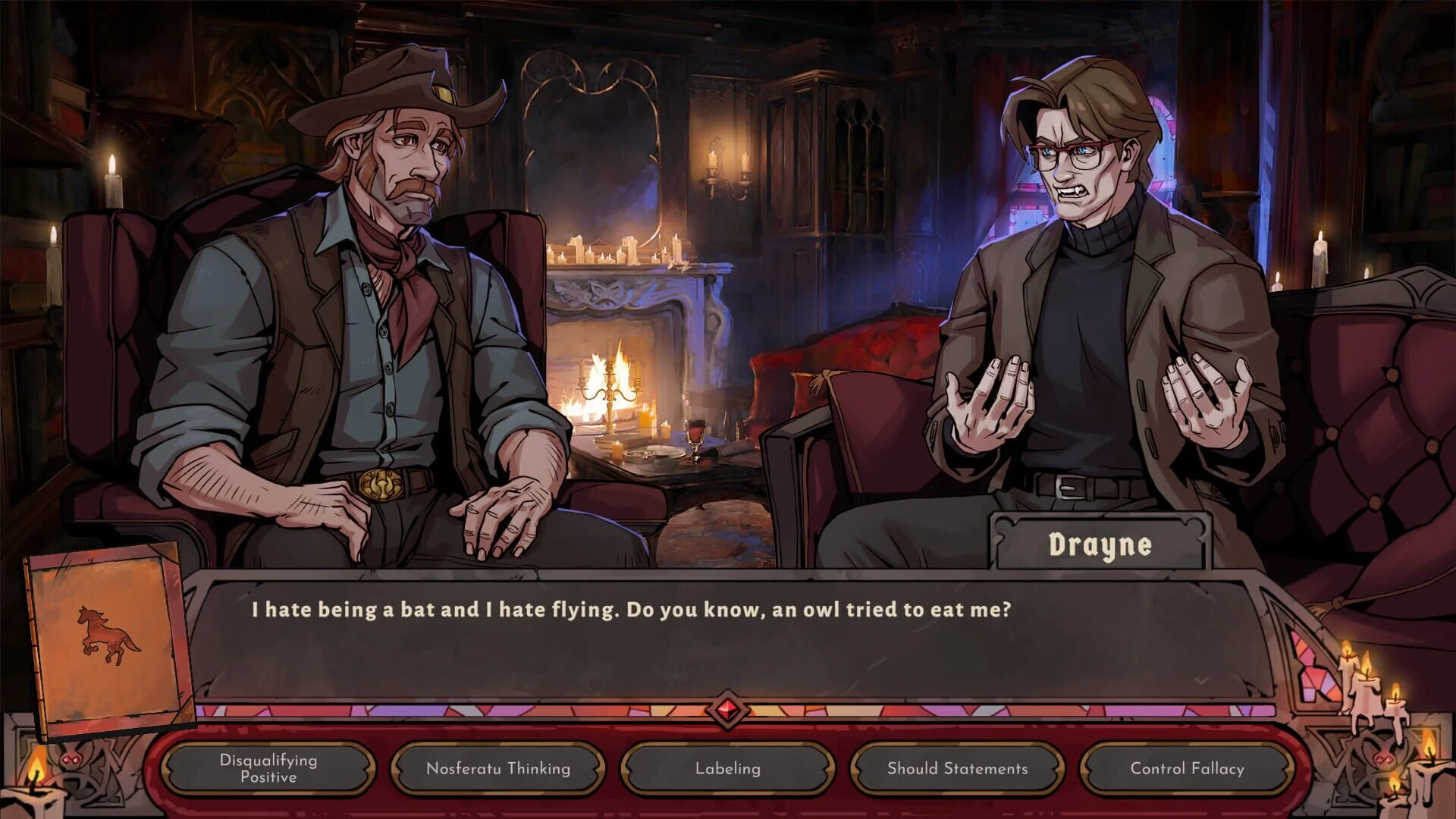
Outside of clients, the core supporting pair is strong:
- Andy – your impossibly ancient mentor, equal parts suave, weary, and gently corrective. He’s the one who steps in when you misstep, pushing you back onto the right CBT track.
- Crimson – the bartender who doubles as your post-session debrief partner. These end-of-day chats became a nice ritual; a chance to digest what just happened, both mechanically and emotionally.
It helps that the voice acting is consistently excellent. Performances feel lived-in rather than over-the-top camp. Andy in particular walks a fine line between aloof and warm, and it works. A lesser performance could easily have tipped him into smug caricature; instead he’s one of the game’s anchors.
The art style backs all this up with a clean, moody aesthetic. Immernacht’s interiors, client portraits, and small visual flourishes complement the dialogue instead of competing with it. It’s not about flashy animation; it’s about framing a conversation so you want to sit in it for a while.
Gameplay: Therapy Sessions, Simple Minigames, and… Not Much Choice
Mechanically, Vampire Therapist keeps things stripped down. Most of your time is spent:
- Reading dialogue during therapy sessions
- Choosing responses that align with CBT techniques
- Talking to Andy and Crimson in between clients
- Occasionally dropping into small, thematic minigames
The minigames are intentionally low-friction. One is built around meditation, and that was the only point where I hit a small wall. The first time it popped up, I spent a few minutes fumbling through the mechanics, wishing the game had given me a short tutorial or visual hint. Once I figured it out, it slotted neatly into the whole “practice what you preach” vibe, but that initial confusion stands out in an otherwise very accessible experience.
Beneath everything sits a very gentle feedback loop: if you pick an unhelpful or incorrect response, Andy often steps in, nudges you toward recognizing the distortion, and gives you another shot. There’s no harsh “you failed the client” screen, no game over, no divergent disaster branch where your bad advice ruins someone’s undeath.
This is both one of the game’s strengths and one of its clearest weaknesses.
On the plus side, it means Vampire Therapist is a very low-pressure game. If you’re anxious about making the “wrong” choices in narrative games—especially one about mental health—this design choice is a relief. The focus stays squarely on learning, not on min-maxing client outcomes.
But as someone who usually loves branching narratives, I also bumped hard against the feeling that my input didn’t really matter. Across my roughly nine-hour playthrough, it became clear that the story beats will land the same way no matter what you do. Andy’s corrections and the lack of consequences dissolve any meaningful sense of risk or agency.
By the final third, I sometimes felt less like Sam the therapist and more like a student skimming through an interactive CBT workbook. I was still interested, I was still learning, but I wasn’t shaping anything. If you’re coming from heavily reactive visual novels where choices create clearly different routes, this will feel flat.
Xbox Port: Smooth, With Minor Bumps
I played on Xbox Series X, where the port is, for the most part, exactly what a narrative-heavy indie like this needs to be: stable, readable, and comfortable to play for long stretches.
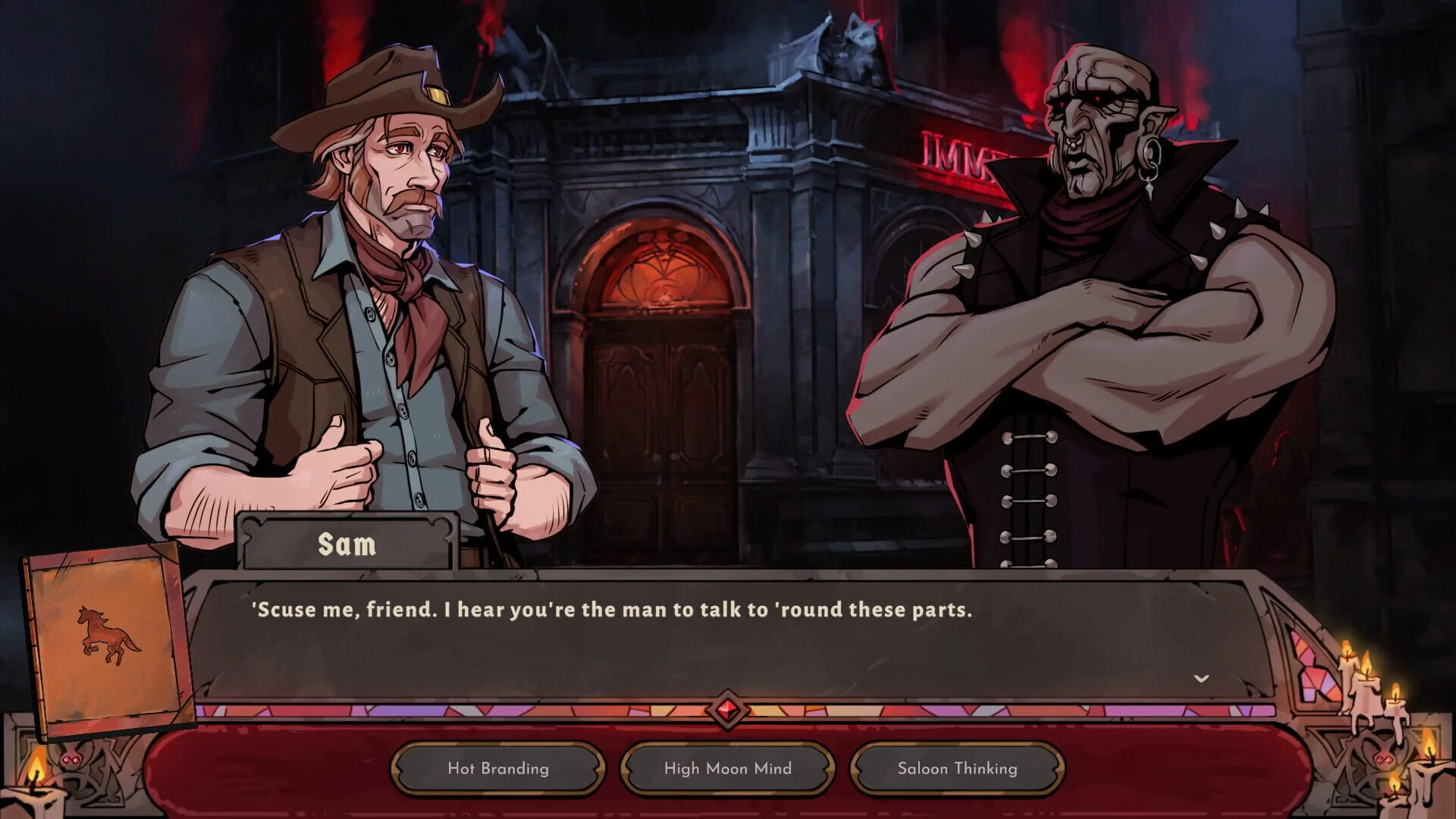
Text is clear on a TV, menus are straightforward, and gamepad controls map naturally to the simple inputs. You’re not juggling complex radial menus or twitch timing here, and that matches the vibe perfectly.
I did run into a handful of small glitches—mostly slightly janky transitions between scenes. They were fleeting: a weird cut here, a brief hitch there. Nothing corrupted a save or broke a sequence, and in a genre where you’re 95% in static dialogue screens, they stayed firmly in the “mildly annoying” bucket.
The Xbox release also includes some extra content, like a “Couples Therapy” section. It’s thematically consistent with the main story: more focused conversations, another angle on how CBT tools can apply, and a fun excuse to dip back into the world after the main credits.
Who Vampire Therapist Is (and Isn’t) For
After living with it for a few evenings, here’s how I’d frame Vampire Therapist to friends.
You’ll probably get a lot out of it if:
- You enjoy visual novels and are happy with a mostly linear story.
- You’re curious about therapy or CBT and want a gentle, narrative-first way to see what it looks like.
- Dark humor mixed with compassion is your thing, especially if you’re into stuff like What We Do in the Shadows.
- You’re looking for a low-stress game you can sink into after work without worrying about failing or grinding.
You might bounce off it if:
- You want strong player agency, impactful choices, and multiple radically different endings.
- Reading-heavy games aren’t your speed; this is text-first with minimal traditional “gameplay.”
- Themes of suicide, abuse, and addiction are too close to home right now; even with humor, it doesn’t sugarcoat them.
- You’re expecting a full-on comedy; it’s funny, but there’s a lot of emotional weight beneath the puns.
Bottom Line: A Smart, Kind Take on Undead Suffering
Vampire Therapist is one of those games that sounds like a joke and then quietly earns your respect. It takes mental health seriously, uses real CBT tools without turning into a lecture, and wraps it all in a stylish vampire nightclub with some of the better indie voice acting I’ve heard in a while.
Yes, it stumbles. Player agency is paper-thin. A few jokes overstay their welcome. The odd glitch reminds you this is a small-team indie. But none of that outweighed how much I enjoyed hanging out at Immernacht, listening to immortal screw-ups unpack centuries of bad coping mechanisms.
By the end, I walked away feeling oddly… calmer. Not because the game magically “fixed” anything, but because it made CBT feel understandable and human. If you’re open to a visual novel that prioritizes empathy and education over branching plots, this is absolutely worth sinking your fangs into.
Score: 8/10 — smart, heartfelt, and refreshingly different, even if it keeps you more on rails than I’d like.
TL;DR
- Premise: You’re Sam, a 200-year-old cowboy vampire learning CBT-based therapy from a 3,000-year-old mentor in a German vampire nightclub.
- Style: Narrative-heavy visual novel with strong writing, excellent voice acting, and a moody, fitting art style.
- Systems: Mostly dialogue choices and light minigames; “wrong” answers get gently corrected, so there’s no hard fail state.
- Strengths: Authentic-feeling CBT techniques, memorable clients, deft balance of heavy themes and dark humor.
- Weaknesses: Very limited player agency, some juvenile sexual jokes, minor technical hiccups on Xbox.
- Length: Around 9 hours for the main story, plus extra content like a Couples Therapy segment.
- Verdict: A thoughtful, funny, and surprisingly educational visual novel that’s ideal if you want story and emotional depth more than interactive complexity.
Laisser un commentaire